
Kennisbank
- Home
- Kennisbank
Peptides explained: Retatrutide & Tirzepatide
Here you will find all information regarding the most popular peptides and their uses.
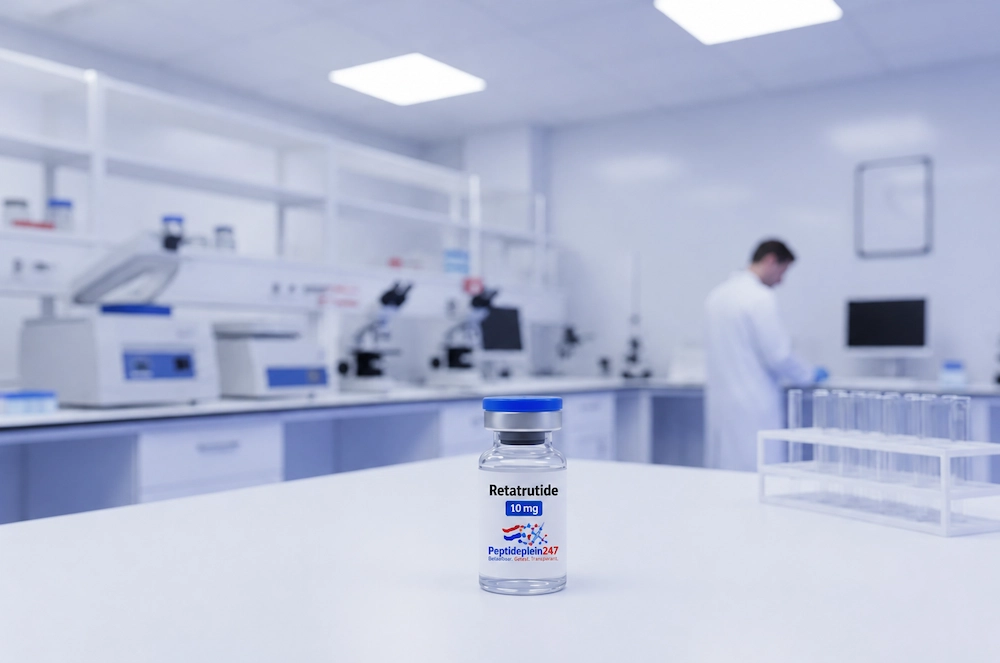
What is Retatrutide?
Retatrutide is a so-called triple agonist , which means that it acts on three important receptors in the body:
GLP-1 receptor
- Involved in hormonal signaling
- Is used in research to analyze biological processes
- Plays a role in complex signal pathways
GIP receptor
- Influences metabolic processes
- Is being studied because of its role in energy balance
- Works together with the GLP-1 receptor
Glucagon receptor
- Involved in energy and metabolic processes
- Is used in research to study broader metabolic effects
Combination effect (unique to Retatrutide)
Because Retatrutide acts on three receptors simultaneously:
- a broad and combined effect is created
- multiple biological processes can be investigated simultaneously
- offers in-depth insight into complex metabolic interactions
Why Retatrutide is interesting in research
In scientific studies, Retatrutide is used to:
- to analyze hormonal and metabolic processes
- to understand receptor interactions
- to study complex biological systems
Disclaimer
Retatrutide is intended exclusively for research purposes and not for human consumption.
What is Tirzepatite?
Tirzepatide is a so-called dual agonist , which means that it acts on two important receptors in the body:
GLP-1 receptor
- Plays a role in hormonal signaling
- Involved in processes related to glucose metabolism
- Is used in research to analyze signal pathways
GIP receptor
- Influences metabolic processes
- Is being studied because of its role in energy balance
- Works together with GLP-1 for combined effects
Combination effect
Because Tirzepatide activates both receptors:
- a synergistic effect arises
- researchers can study multiple processes simultaneously
- offers insight into complex biological interactions
Why this is interesting in research
In scientific studies, Tirzepatide is used to:
- to better understand hormonal signaling
- to analyze interactions between receptors
- to investigate metabolic processes
Disclaimer
Tirzepatide is intended exclusively for research purposes and not for human consumption.
What do I need to use it?
- Alcohol wipes.
How do I store the peptides?
After mixing, store the peptide in the refrigerator (2-8°C). It is then often shelf-stable for 4 to 90 days, depending on the type of peptide.
How does the dosage and ratio work?
The amount of water depends on the dosage. Often, 1 ml to 2 ml is used for 10 mg of powder. So, if you want to use a dose of 10 mg per week, add 1 ml of water and fill the syringe to 100 units.
Step-by-step plan for mixing
Preparation: Allow the vial of peptide to reach room temperature if it comes from the refrigerator/freezer. Wash your hands thoroughly.
- Disinfect: Clean the rubber stoppers of both the peptide vial and the bacteriostatic water with an alcohol wipe.
- Drawing up water: Draw up the desired amount of bacteriostatic water into the syringe.
- Inject (carefully): Insert the needle through the stopper of the peptide vial. Slowly inject the water , letting it run down the inside of the vial, not directly onto the powder.
- Dissolve (do not shake): Remove the needle and gently swirl/rotate the bottle (do not shake!) until the powder is completely dissolved. The solution should be clear.
- Labeling: Note the date of mixing on the bottle.
Discover Research Peptides with Transparent Specifications
Are you looking for a reliable supplier of research peptides in the Netherlands? Peptideplein247.nl offers high-quality peptides with clear product specifications and batch information.
- View the full range
- Order safely online
- Benefit from fast & discreet shipping
- Affordable and tested